
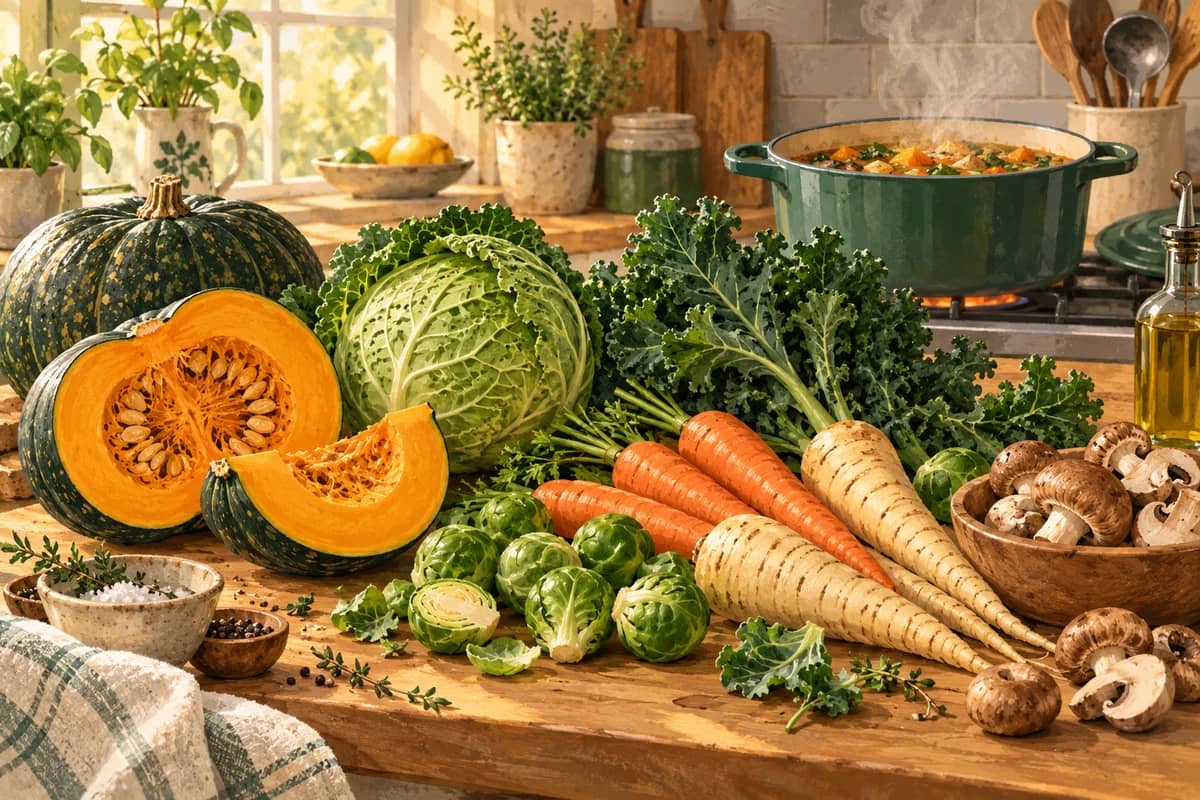
What you’ll learn
- Choose produce for its condition and cooking role; local availability varies with place and season.
- Cut dense roots evenly and give roasting vegetables room to brown.
- Pair a tender cooked vegetable with something fresh, acidic or crisp.
Roots, squash, cabbage and hardy greens can make winter vegetarian meals colourful and varied. Some are useful storage crops, while others need using more quickly. Availability depends on where you live and how the produce was grown or stored, so treat this guide as cooking help rather than a promise that every listed vegetable is locally in season.
Shop for condition and the meal you intend to make
Choose firm roots without soft or wet patches, cabbage with crisp leaves and squash with an intact skin. Buy quantities that fit a few planned meals. A large bag can be useful when you roast, simmer and mash the same vegetable in different dishes, but it is poor value if most remains unused.
Match the vegetable to its cooking job
Scroll across to see all columns.
| Group | Useful approach | Recipe direction |
|---|---|---|
| Carrots and parsnips | Roast even pieces or simmer until tender | Root Vegetable Quinoa |
| Squash | Roast, purée or fill its cavity | Stuffed Acorn Squash |
| Cabbage and Brussels sprouts | Shred finely or roast with room on the tray | Cranberry Citrus Slaw |
| Kale and leafy greens | Remove tough stems and cook or slice to suit | Kale Caesar Salad |
| Mushrooms | Brown until released moisture evaporates | Mushroom Stroganoff |
Store whole vegetables without trapping moisture
Follow packaging instructions where supplied. Keep leafy greens and brassicas refrigerated and avoid leaving them wet in a sealed bag. Whole squash can suit a cool, dry place, while cut squash needs refrigeration. Store potatoes away from light and remove any that become damaged or spoiled.
Leave produce whole until you know when you will use it, unless preparing it makes an upcoming meal easier. Once cut, cover and refrigerate appropriate vegetables, keeping them away from ready-to-eat food if dirt remains on the skin. Label prepared containers so similar-looking roots do not become a guessing game.
Roast dense roots until the middle is ready
Cut carrots, parsnips and squash into pieces of similar thickness. Spread them with gaps, coat lightly with the recipe’s oil and turn when the underside colours. A crowded tray holds steam, so use a second tray if needed. Test a thick piece: browned edges do not prove the centre is tender.
Use Moroccan-Spiced Root Vegetable Quinoa for measured roast roots and squash. Cheddar Polenta with Roast Vegetables gives a different creamy base. These actually contain squash; the potato topping in lentil shepherd’s pie is a separate ingredient and method.
If one vegetable cooks faster, give it its own part of the tray or add it later as the recipe allows. Similar-looking pieces can still differ in density and water content.
Use brassicas and greens in different textures
Finely shaved sprouts and cabbage can become a crisp slaw; dry them well before dressing and keep nuts separate until serving. A guarded slicing tool can help, but its food holder is essential. A sharp knife and stable board also work; our knife-skills guide covers manageable cuts.
Roasting cauliflower gives browned edges, while a whole crown needs enough time for the central stem. Try Herb-Roasted Cauliflower and test the thickest part. Remove tough kale stems and slice leaves to suit the dish rather than assuming every green needs the same treatment.
Finish substantial dishes with something fresh
Lemon juice, herbs, a pickled vegetable or a fresh salad can brighten a rich bake. Add them after the long cooking when you want a fresh flavour. Seeds or nuts provide a distinct crunch, but keep them separate from moist sauces until the plate is ready.
Turn spare cooked roots into a grain bowl or blend suitable vegetables into a soup using a written recipe for its liquid and seasoning. That is different from repeatedly warming the same leftovers. Follow the original dish’s storage note and plan a suitable freezer portion if you will not use it soon.
Choose one main from vegetarian comfort food, then add one vegetable cooked differently. A roast main with a crisp slaw, or a creamy polenta bowl with browned roots, gives contrast without a long menu.
Keep exploring
Vegetarian Recipes Kitchen
Our collection focuses on practical vegetarian cooking, measured ingredients, plant-based substitutions, and clear methods. New recipes are editorial drafts; photography may be AI generated. We do not claim hands-on testing unless a recipe explicitly documents it.
View all posts by Vegetarian Recipes Kitchen