
What you’ll learn
- Secure the board and create a flat surface on round vegetables before cutting.
- Choose the cut to suit cooking time, texture and how the food will be served.
- Practise slowly with a comfortable knife; speed follows control.
Vegetarian cooking involves plenty of peeling, trimming and chopping. A stable setup and a few repeatable cuts make that preparation calmer. You do not need restaurant speed or a collection of specialist knives. Start with control, choose a manageable blade, and make pieces that cook evenly.
Set up a stable working area
Put the board on a clear, level counter. If it slides, place a damp cloth underneath and check that it sits securely. Give yourself room to move prepared vegetables into a bowl without reaching across the blade. Keep the knife flat on the board when you pause, with its edge away from the counter edge.
Choose a knife whose handle and weight feel comfortable. A chef’s knife is versatile, but an oversized blade can feel awkward. Use a smaller suitable knife for delicate trimming. Follow the maker’s care and sharpening guidance; honing and sharpening are different jobs, and neither requires doing it automatically before every meal.
Guide the blade and protect your other hand
Hold the handle firmly without squeezing until your hand tires. A pinch grip, with thumb and index finger resting against the blade near the handle, can give control if it feels comfortable. Keep fingers away from the sharp edge. With the other hand, curl fingertips inward and move them back gradually as you cut.
Look at the cutting area, work slowly and stop before adjusting an ingredient. Never try to catch a falling knife. When transferring chopped food, use a scraper or the blunt spine carefully rather than dragging the cutting edge sideways across the board. Keep knives separate from loose dishes when cleaning.
A flat surface makes a round ingredient more stable. Cut a carrot, courgette or onion to create a secure side, then place that side down before continuing.
Learn four cuts you will use often
Choose a cut for the job
Scroll across to see all columns.
| Cut | How to approach it | Where it helps |
|---|---|---|
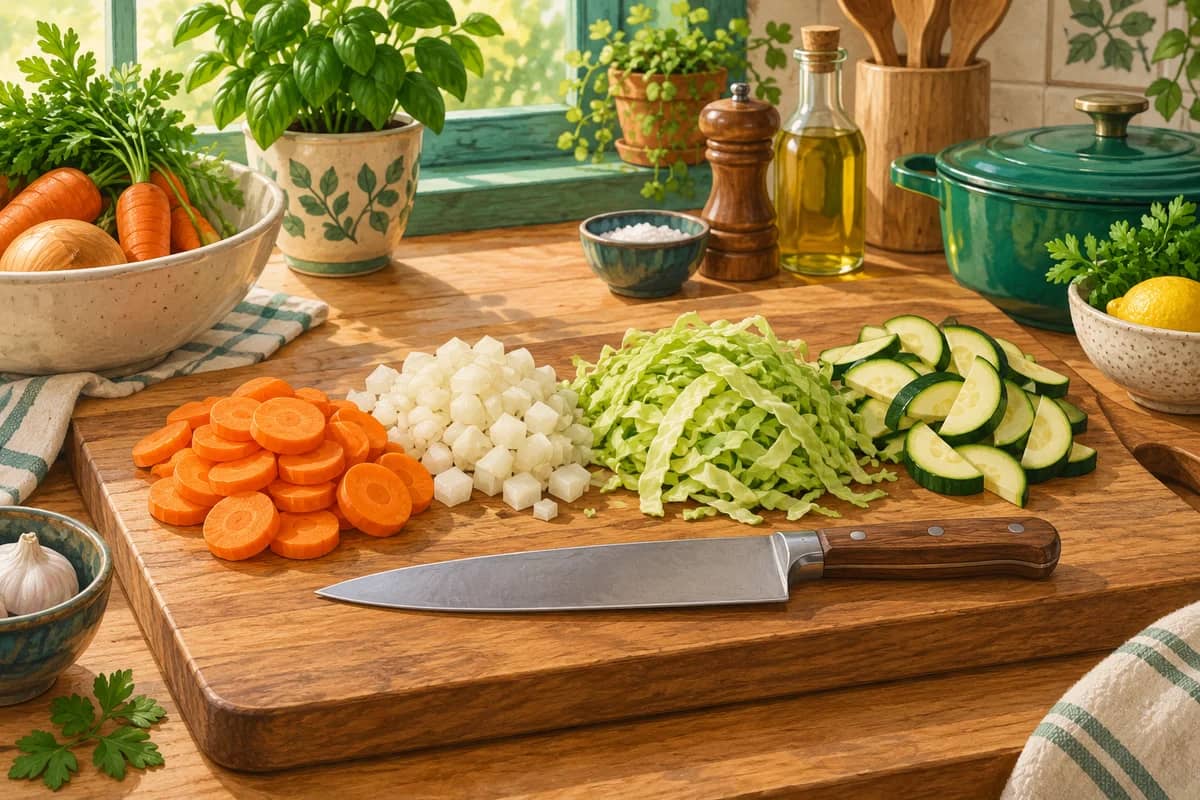
| Coins or half-moons | Slice across a stable carrot or courgette; halve lengthways first when useful | Soups, sautés and quick vegetable sides |
| Dice | Make even slices, then strips, then cross-cut into cubes | Onion bases, fillings and chopped salads |
| Thin ribbons | Stack a few leaves loosely and slice across them | Cabbage bowls, kale and herb finishes |
| Even chunks | Cut sturdy vegetables into pieces of similar thickness | Roasting trays and stews |
Uniformity matters more than a perfect geometric shape. A large carrot chunk takes longer than a thin slice. When combining vegetables on a tray, consider density as well as size: softer courgette may finish before a thick piece of sweet potato. Follow the recipe’s preparation notes instead of cutting everything the same way by habit.
Handle awkward vegetables in stages
Trim cabbage into manageable wedges before shredding. Keep a cut face down and remove the tough core as needed. For onions, halve and peel first, place the flat side down, then make controlled cuts with the root end helping hold the layers together. Stop when the remaining piece becomes too small to hold securely.
Hard squash needs extra care. Use a stable board and suitable knife, work with manageable sections, and do not force a blade through a rolling whole squash. Buying prepared squash is a reasonable option when the ingredient feels difficult to handle. A guarded slicer also needs its food holder; bare fingers should not approach its blade.
Practise during an ordinary recipe
Try carrot and cabbage preparation in Vegetable Spring Rolls, where narrow pieces make rolling easier. Use Roasted Veggie Buddha Bowls to practise evenly sized roasting vegetables. Read all preparation notes before starting so you know which ingredients need separate bowls.
Work through one ingredient at a time, clear scraps regularly and keep the board dry enough to stay predictable. If your pieces are uneven, slow down and check your setup; rushing through the rest of the pile rarely improves them. Leave intricate garnish cuts for another day.
Choose a vegetarian recipe with two or three vegetables and practise one cut deliberately. Once it feels comfortable, build another cut into your next meal rather than turning every dinner into a knife-skills exercise.
Keep exploring
Vegetarian Recipes Kitchen
Our collection focuses on practical vegetarian cooking, measured ingredients, plant-based substitutions, and clear methods. New recipes are editorial drafts; photography may be AI generated. We do not claim hands-on testing unless a recipe explicitly documents it.
View all posts by Vegetarian Recipes Kitchen